Boxing Footwork for Beginners: How to Move
Without Losing Balance
A practical introduction to stance, small steps, pivots, and simple drills that
make every punch and defensive movement more dependable.
A beginner can learn the punches in boxing and still feel unsteady if the feet do not know where
to go. Footwork is what lets you reach the bag without falling forward, leave safely after a
combination, and stay composed when the direction changes. It is not flashy at first, but it makes
everything else work.
The good news is that effective beginner footwork is built from a few small movements. You do
not need fast feet on day one. You need balanced feet, a repeatable stance, and enough
patience to move only as far as you can control.
Start with a stance you can move from
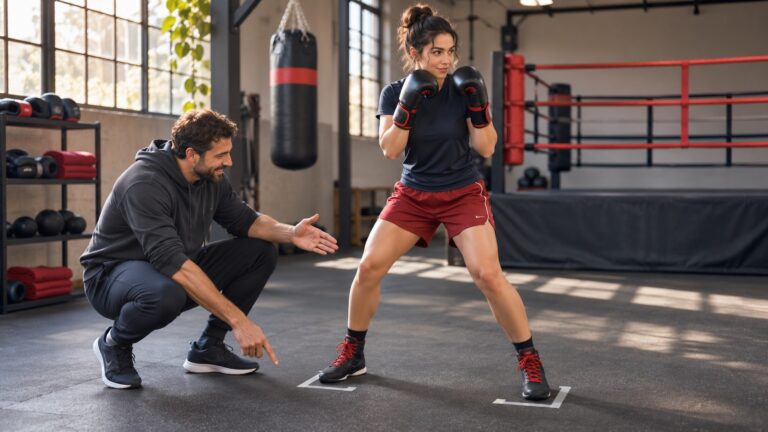
Your coach will help you choose an orthodox or southpaw stance and adjust it to your body. In a
basic stance, the feet are separated front to back and side to side, the knees remain soft, and the
weight is balanced enough that either foot can move. The rear heel is light, the chin is protected,
and the hands are ready without the shoulders becoming rigid.
Test the stance before adding punches. Can you take a small step forward, backward, left, and
right without bringing your feet together? Can someone give your gloves a gentle push without
your upper body tipping? If not, reset the base. Balance is the first skill.
Move small enough that you could stop, punch, or change
direction at any moment.
The nearest-foot-first rule
A simple rule keeps most beginners organized: the foot closest to the direction of travel moves
first, and the other foot follows to rebuild the stance. To move forward, step with the lead foot
and let the rear foot follow. To move backward, the rear foot begins. To move left or right, the
foot nearest that side starts the motion.
Think step, then replace—not step, then drag your stance into a different shape. The following
foot travels approximately the same distance as the first, so your base remains familiar. Coaches
may use different terminology or make tactical adjustments, but this rule is a dependable place
to begin.
Why crossing your feet causes trouble
Crossed feet narrow your base and make it harder to punch, defend, or change direction. They
often appear when a beginner takes a long side step or tries to move faster than the stance
allows. The fix is not to hurry. Reduce the step, allow the nearest foot to lead, and rebuild the
original spacing.
Feet that become too close create a similar problem. Feet that spread too far apart can leave you
stuck and reaching. The goal is not a mathematically perfect distance. It is a stable shape that
travels with you.
Four movements to learn first
1. Step forward and back
Use a quiet lead-foot step to enter range, then bring the rear foot with you. Reverse the
sequence to leave. Keep the head over the base rather than lunging the chest ahead of the front
knee. Practice without punches until stopping feels as controlled as starting.
2. Step left and right
Move the near-side foot first and follow with the other. Your shoulders and hips continue facing
the same general direction. This is not a sideways shuffle with both feet leaving the floor at once.
It is two short, connected actions.
3. Pivot
A pivot changes your angle without surrendering your balance. A common beginner version
plants the lead foot lightly and lets the rear foot travel around as the hips turn. The knees stay
soft, and the stance reappears at a new angle. Learn it slowly with a coach; twisting against a
planted knee is not the goal.
4. Step out after punching
A combination should not end with you frozen in front of the target. After a jab or one-two,
recover the hands and use a controlled step or pivot to leave the line. This develops the habit of
finishing in a position where you can defend.
Add the jab without losing your base
Once your steps are consistent, pair the jab with a small forward step. The lead foot and jab can
arrive together while the rear foot follows to restore the stance. Avoid reaching the head and
shoulders far beyond the front foot. If the target is still too far away, reset and step again rather
than stretching the punch.
Next, jab while moving backward under a coach’s direction. The feet organize the distance while
the hand gives you a tool to interrupt an approach. The pace should stay slow enough that your
posture and guard remain intact.
Three beginner drills with a clear purpose
- Tape-line drill: place a straight line on the floor and take controlled steps along it without
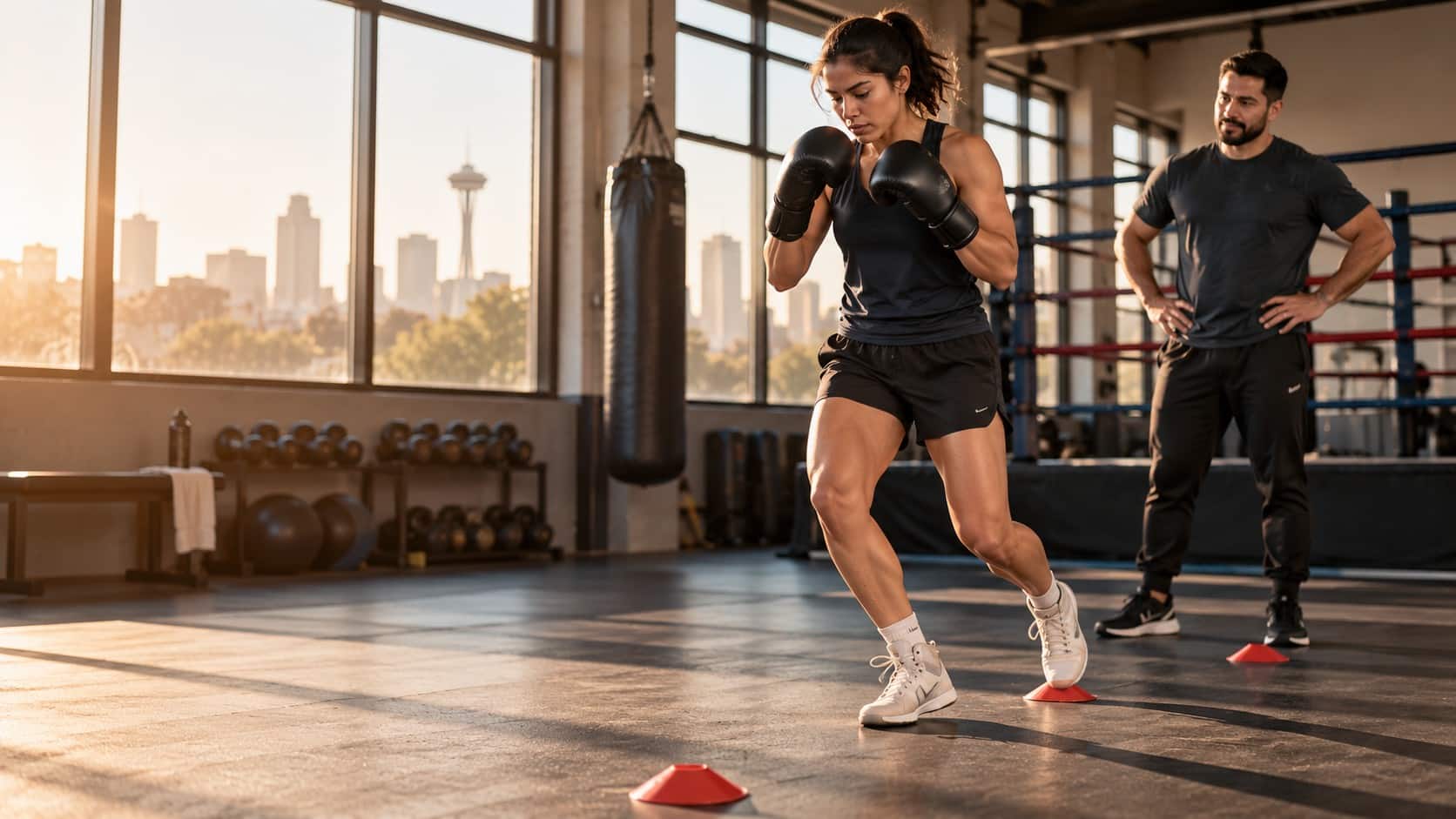
letting the feet cross or collapse together. - Compass drill: imagine forward, back, left, and right points. Move to the coach’s call, reset
your stance, and hold the finish for one second. - Bag exit drill: throw one or two straight punches, recover your guard, then step or pivot away
before repeating.
Short rounds are ideal. Work for 30 to 60 seconds, rest, and repeat with one focus. When fatigue
makes the feet slap, cross, or widen, slow down. Practicing poor movement faster does not
create good footwork.
Common mistakes—and the coaching cue that helps
- Bouncing constantly: keep the movement economical and let the feet skim or step quietly.
- Taking giant steps: imagine the floor is slippery and shorten the stride.
- Standing tall and stiff: soften the knees so the body can start and stop.
- Looking down at the feet: keep the eyes forward and use floor markers only as peripheral
guides. - Punching before the stance is set: earn the punch by arriving balanced.
How to practice at home safely
You need only a clear, non-slip area and a few minutes. Put away anything you could trip over,
wear the footwear your coach recommends, and shadowbox at low intensity. Begin with stance
checks, add single-direction steps, then connect two directions. A mirror can help, but do not
stare down at the feet.
Five focused minutes several times a week can be more valuable than one exhausting session.
Stop if you feel joint pain, dizziness, or instability. Footwork practice should build control, not test
how tired you can become.
What early progress looks like
Progress may sound ordinary: your steps become quieter; the stance stays the same width; you
stop falling into the heavy bag; you can jab and exit without looking at the floor. These changes
mean your body is learning to organize itself while your attention moves to the opponent or
target.
Speed comes later. First, become the boxer who is balanced before, during, and after every
action. When your feet give you a reliable platform, punches become cleaner, defense becomes
calmer, and boxing starts to feel less like a collection of movements and more like one connected
skill.
Try a beginner-friendly Brazilian Jiu Jitsu class at San Antonio Grappling Academy. Our
coaches will help you learn at your pace, answer your questions, and give
you a clear path forward. Contact the academy today to schedule your first
class.